
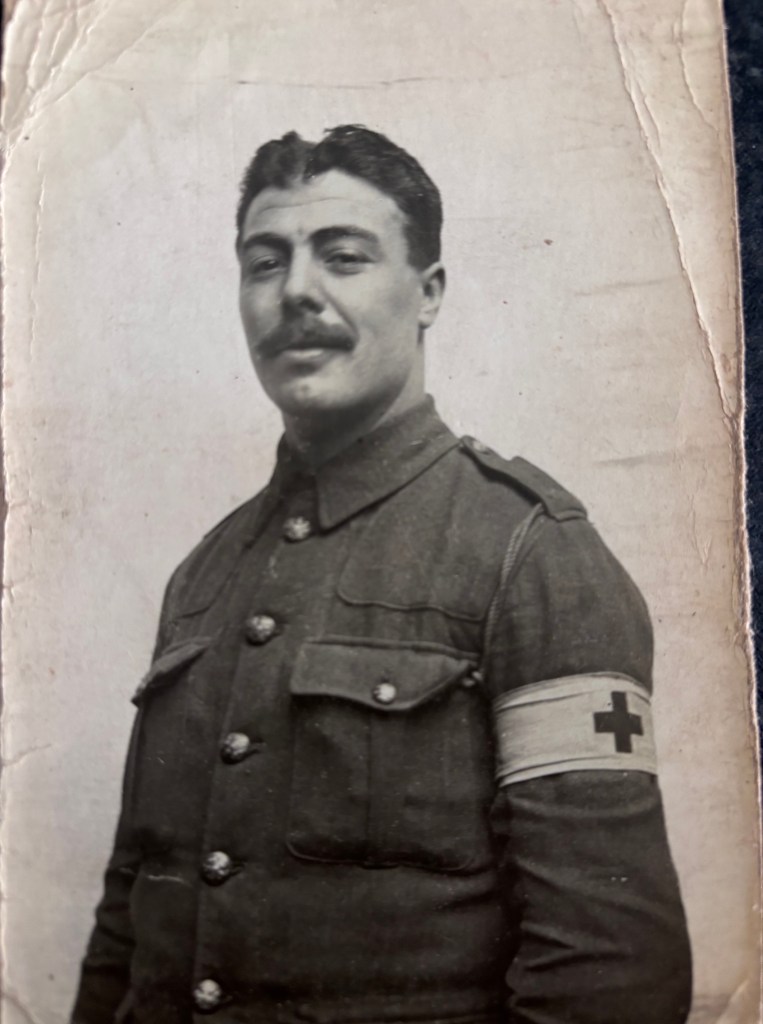
Private Edmund Brame Royal Army Medical Corps.
Service Number 20671
11th Field Ambulance
4th Division
British Expeditionary Force
B Company
b.1887 in Trimley St Martin
d.1983 in Wiltshire
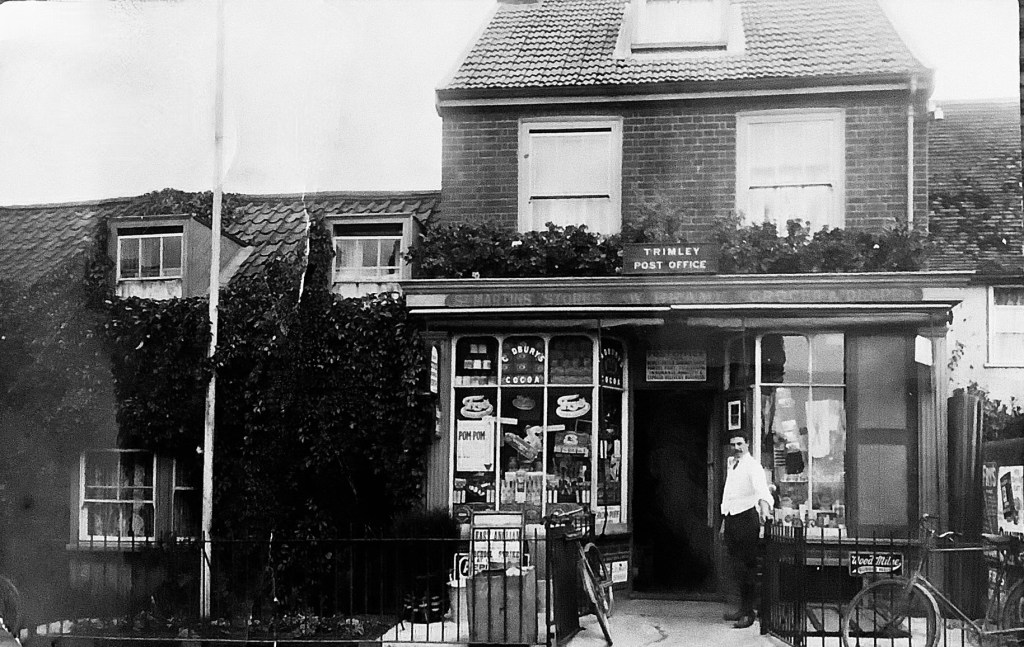
A young Shop Assistant stands outside Trimley Post Office. Wearing a white waistcoat and an apron tied around his waist he invites the casual passerby to enter the shop. Who is this neatly apparelled man? According to the message on the back of the postcard addressed to his young cousin, Millie Reynolds and written by the young man’s wife, Lily Brame on the 11th September, it is:
“…the boy Ted come to see you”
Edmund, better known as ‘Ted’, was one of eight children: Alice, Amelia, William, Edmund, Bertie, Stanley, Hilda and a deceased infant, Henrietta. His parents were William and Phyllis Brame and at the time of the photograph Ted was working in his father’s business, ‘St Martin’s Stores and Post Office’. Lily was his wife of two years. They lived in Eagle House, opposite the Post Office during a period which came to be regarded as the golden days of an Edwardian summer. Prosperity for many was rising. Ted and Lily’s existence was peaceful and non-eventful as it was for many in the two Trimleys. But external forces beyond the control of working people were shaping their futures. Throughout the period international tensions were rising and by 1914 the ambitions of the various ‘Empires’, Britain, Russia, Germany and others, were moving towards conflict. It was an eventful year for Edmund Brame. In June he enlisted in the Royal Army Medical Corps (R.A.M.C.) and was sent away to Training Camp. His Great Granddaughter emphasised Ted was a not an aggressive man, as is indicated by his entry into the R.A.M.C. with its mission to care for the sick and wounded. But it’s not clear why he enrolled in advance of war. Perhaps as an expectant father he felt a moral imperative to protect his much loved wife and unborn child. Being a compassionate man, the object of the R.A.M.C. may have resonated with him. It was,
“The prevention of disease and… the care and treatment of the sick and wounded.”
When Ted joined the Royal Army Medical Corps as a Private his pay was 1/- a day[i] and likely to be more than he earned as a Shop Assistant. The R.A.M.C. trained the Corps to the same standards as the Army Privates. The official march of the R.A.M.C. was, “Her bright smile haunts me still”, which includes these lyrics,
“Sweet dreams my memory fills
And from sleep when I arise
Her bright smile haunts me still…”
Did these words resonate with Ted, who was many miles and years away from Lily. This music is still performed today although more within the Folk Tradition than a military one. You can listen do different versions on YouTube[i]
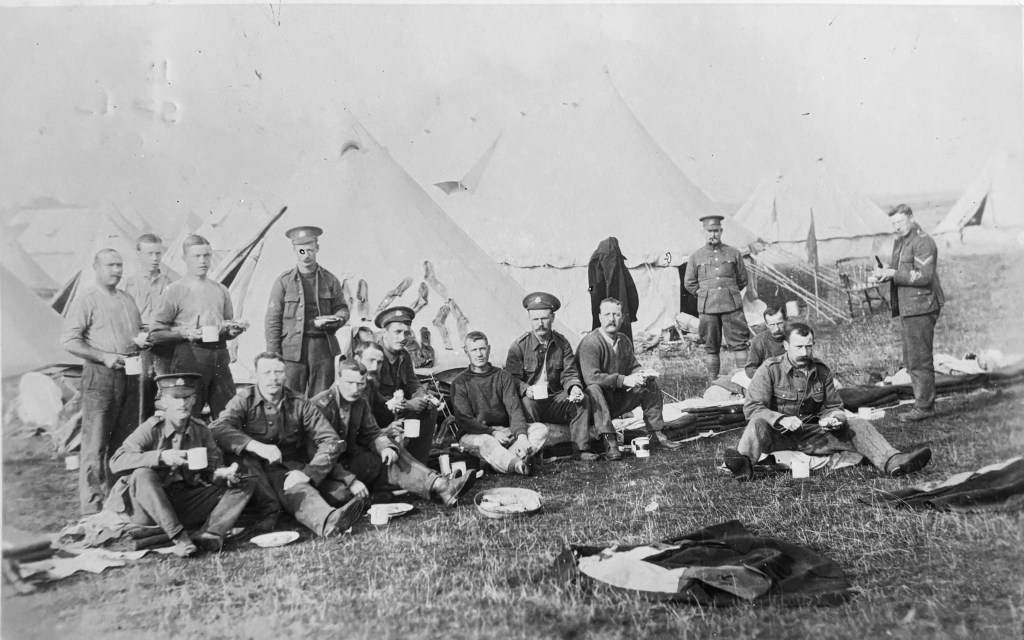
Shortly after enlisting, a baby girl was born to Edmund and Lily on the 22nd June 1914. Marjorie Maud Brame, “Madge”, would wait a long time before she properly met her father because wider wheels were turning. Six days after her birth, on June 28th, Archduke Franz Ferdinand and his wife, Duchess Sophie, were assassinated in Sarajevo. Within a month the Austrian- Hungarian Empire retaliated by declaring war on Serbia. Other countries, notably Russia and Germany were pulled into the martial vortex. Britain was also deeply affected. Further events compounded the growing European hostilities and as Sir Edmund Gray stated to The House of Commons on 3rd August,
“We are in the presence of a European conflagration; can anybody set limits to the consequences that may arise out of it?”[i]
The following day, 4th August 1914, Germany invaded Belgium by crossing its territory as it marched towards France. In the face of this aggression, Britain declared war on Germany on the same day. And the bloody game commenced.
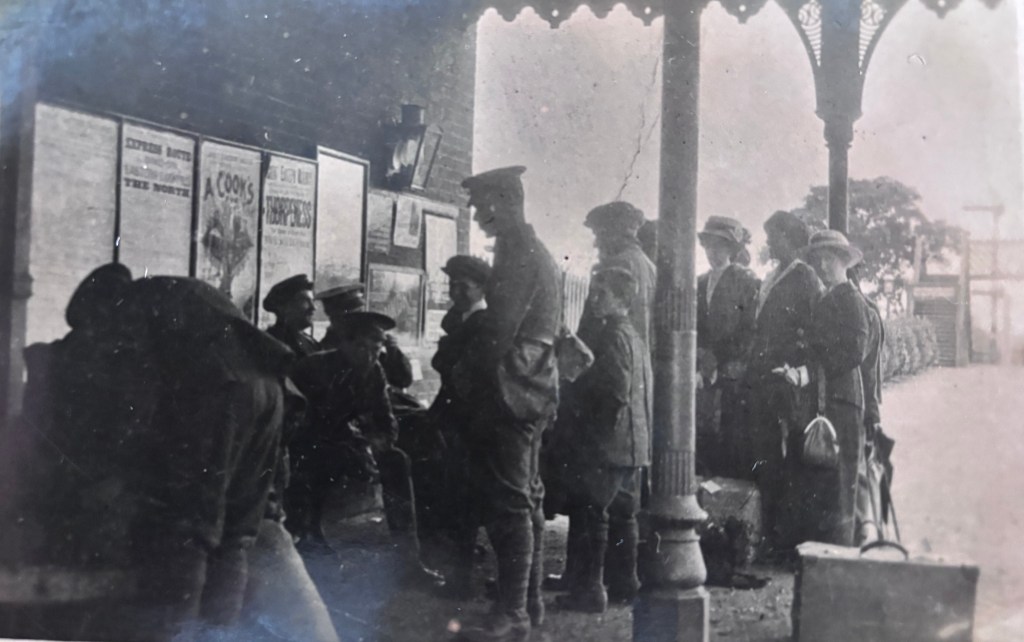
In this time-faded photo, a cluster of men wait on the up platform of Trimley Station to join their Units in the Summer of 1914. Ted is seated and faces the camera, although he is very much in the shade. Courtesy of K.T.
How did this affect Ted? Quickly following on from his initial training and the declaration of War, Ted became part of the British Expeditionary Force sent to France to support their war efforts. But what did the Royal Army Medical Corp do? In earlier conflicts medical aid was placed well behind battle lines:
“It was apparently the custom everywhere, down to the beginning of the nineteenth century, for the surgeons with their necessary appliances to remain some considerable distance at the rear of the battlefields and only succour and aid such as were brought to them…”[i]
But this was to change and during the First World War it rapidly retrieved casualties from the battlefields, then taking them to the various hospitals and field stations. The R.A.M.C. served across the globe in France, Belgium, Macedonia, Italy, Palestine, South Russia and Mesopotamia, all of which became embroiled in the War.
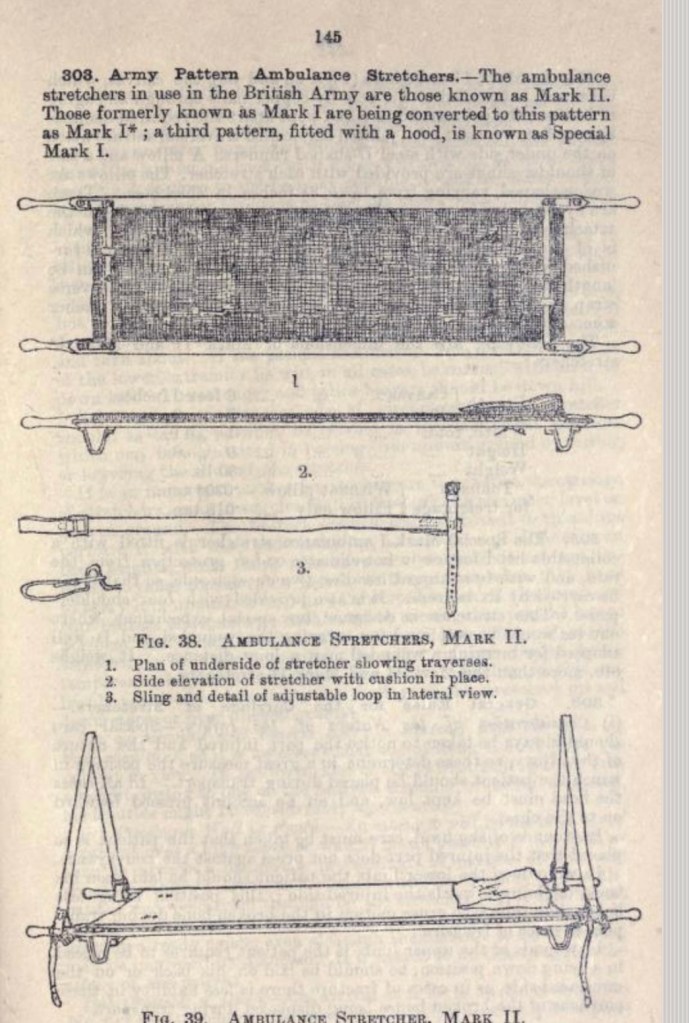
The Field Ambulance wasn’t a vehicle but medical unit working on the front line, manned by the troops of the Royal army Medical Corps. Field Ambulances came under command of a division. When it was at full strength a Field Ambulance was composed of ten officers and two hundred and twenty four men. Each had special responsibility for the care of casualties for a specific Brigade within the Division. Theoretically, the Field Ambulance could handle one hundred and fifty casualties, but it quickly became apparent that in battle far more would require treatments. The Field Ambulance dealt with casualty evacuation and their treatment. They gave succour to those wounded in battle by removing them from the action and taking them to the nearest dressing station. Those with slight injuries were expected to walk.
“Careful carriage” by stretcher was for the more seriously injured.
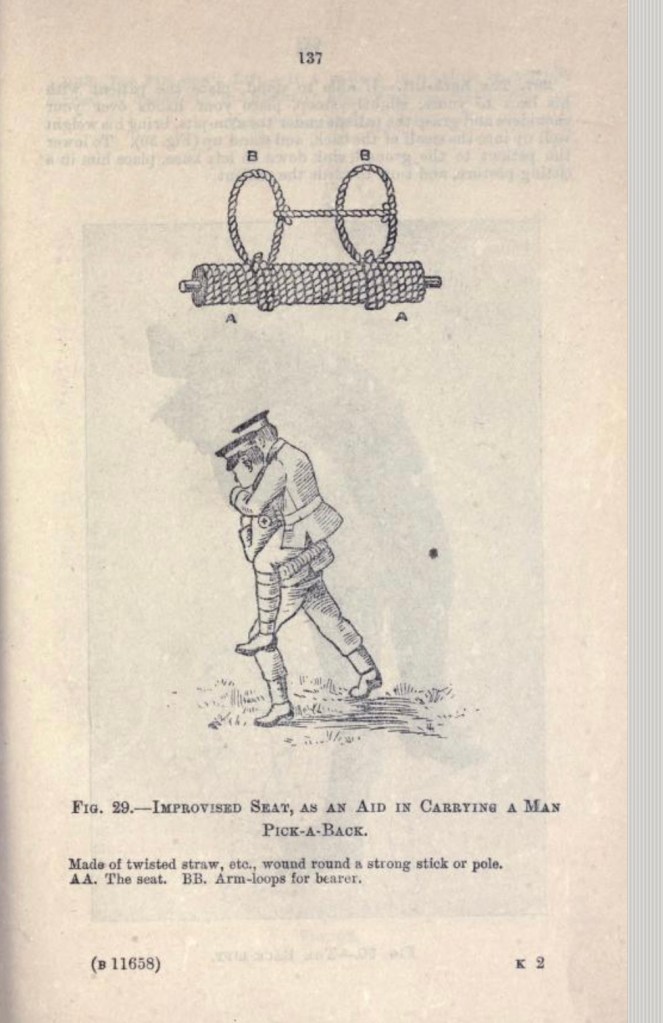
Others with lesser wounds may have received rudimentary transport such as piggy backs.
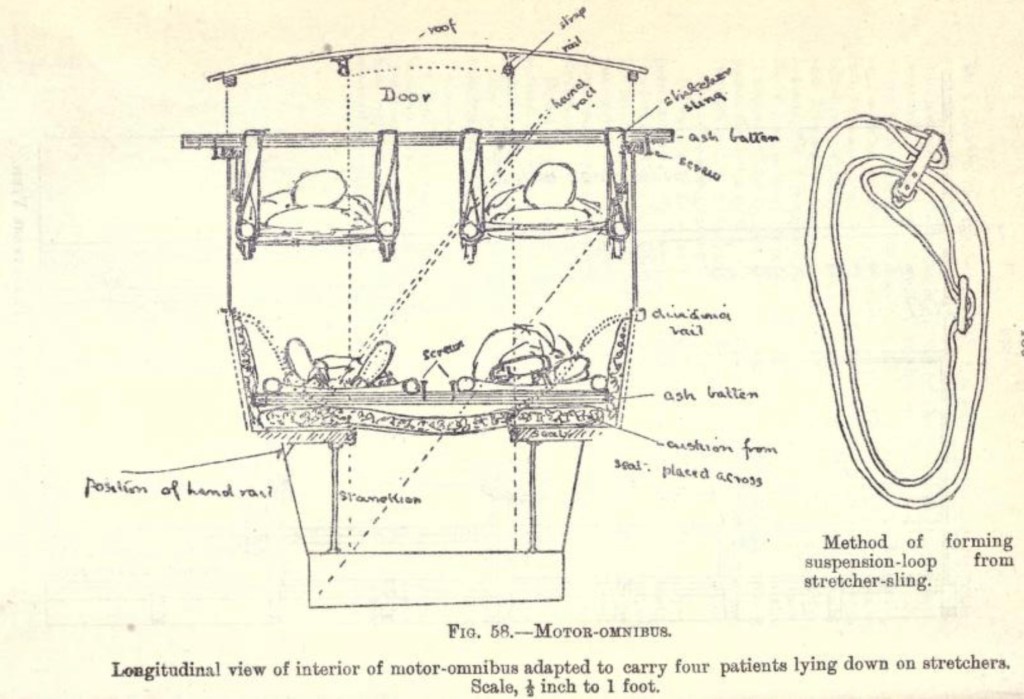
At the very start of the War, motorised vehicles were unavailable and transport was by horse driven ambulances, which exacerbated the pain and suffering of the injured. It was quickly realised the modern motorised vehicles were the swiftest method of rescuing men from the battle fields and these motor-omnibuses were rapidly deployed:
Ted saw action in many arenas and Karen, his Great Granddaughter, gave me the following outline of his career.
Commencing in August 1914:
- 26th August 1914 The Battle of Le Cateau. Ted’s division fought in this action without its Mounted Troops, Heavy Battery, Divisional Ammunition Colum, Field Companies RE, Signals Company RE, Field Ambulances RAMC and Divisional Train, which were all still enroute from England.
- 6th to 10th September, The Battle of le Marne
- 13th to 28th September, The Battle of L’Aisne, then the Battle of Messines.
- Despite the deployment of well trained and experience soldiers, nearly all the original B.E.F. fighting forces were wiped out by December 1914.[i] The medical corps carried on and so did Ted.
- 22nd April to 25th May 1915, The Second Battle of Ypres
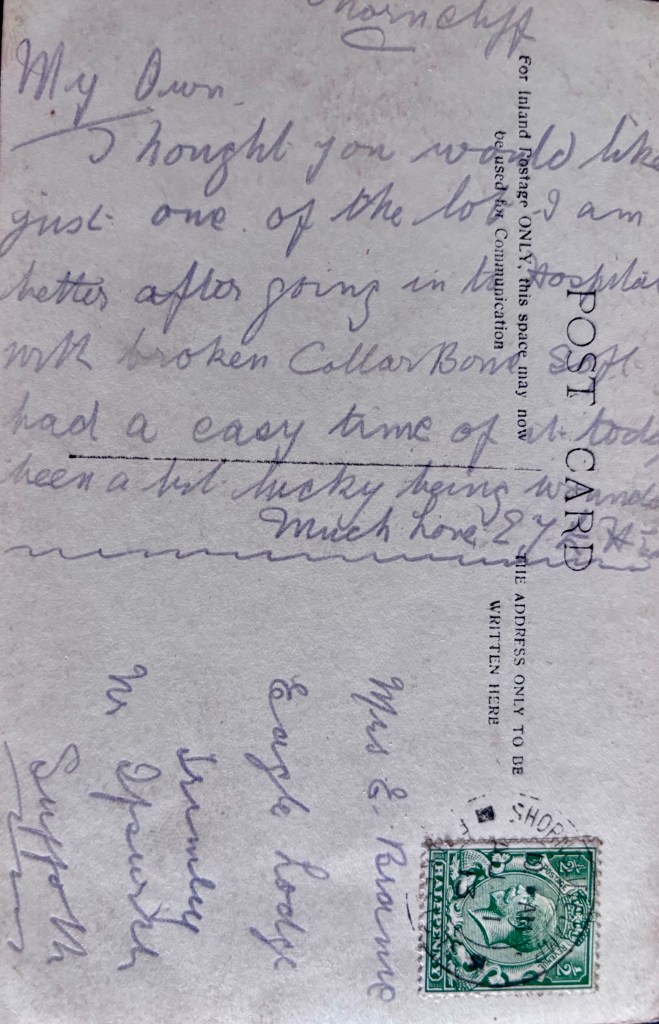
- 15th May 1915 Ted was wounded under fire and becomes an “Old Contemptible” His Great Granddaughter told me, “He was given shelter in a convent, where the nuns nursed him. I have the simple wooden crucifix they gave him when he returned to the front.” On his postcard Edmund cheerfully reported, “… I am better after going into hospital after broken collar bone so I’ve had an easy time of it today been a bit lucky being wounded…” The post card was posted in Shorncliff, situated between Folkestone and Hythe in Kent and close to Sandgate. During the First World War it was used as transit point for troops going to the Front. The postmark suggests Ted was discharged back to England at some point, perhaps for convalescence but he didn’t return to Trimley.
- Nov 1915, The Battle of Le Transloy
- 1st to 13th 1916 July the Battle of Albert ,
- 1st Oct to 5th Nov – Battle of Le Transloy
- Both of these were part of the wider offensive in the Battle of the Somme
- 9th April to 4th May 1917 the 1st Battle of Scarpe
- 3rd to 4th May the 3rd Battle of Scarpe
- Both of these were part of the Battle of Arras
- Ypres 26th September to 3rd October 1917 – Battle of Polygon Wood
- As part of the Battle of Passchendale
- on 4th October 1917 the Battle of Broodseinde, Flanders
- 9th October 1917– Battle of Poelchapelle
- Ted also saw action in
- Fourth Battle of Ypres 7th to 29th April 1918
- The Battle of Lys 4th to 18th April, the Battle of Bethune
- 12th to 15th April 1918, the Battle of Hazelbrouck
- 25th August to 3rd September 1918 he was at the Battle of Arras in which the battalion fought in the Defence of Hinges Ridge.
It also seems that Ted was in Italy at some point, or at least according to a 1952 newspaper article in the Felixstowe Times. He was mainly a stretcher bearer and braved the perils of rescuing wounded comrades on the Battlefields. Like many of his generation, he didn’t necessarily speak about his experiences. But we do know he demonstrated exemplary courage because he received the three 1914 – 18 war medals[i] shown below and the Medal for Meritorious Service. In 1924 he was awarded the Clasp and Roses embellishment for his 1914 Star, which was awarded to those who served under direct enemy fire.
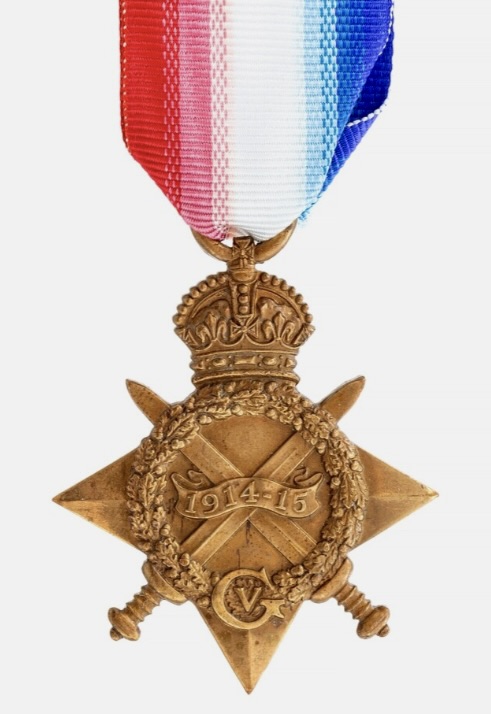
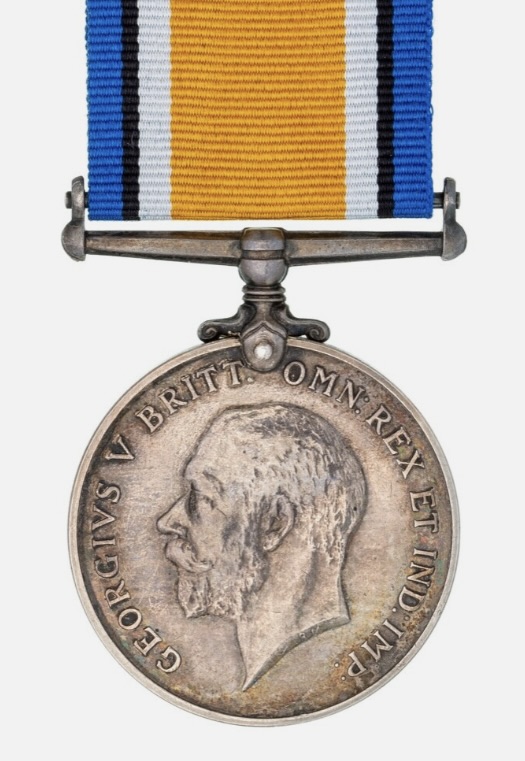
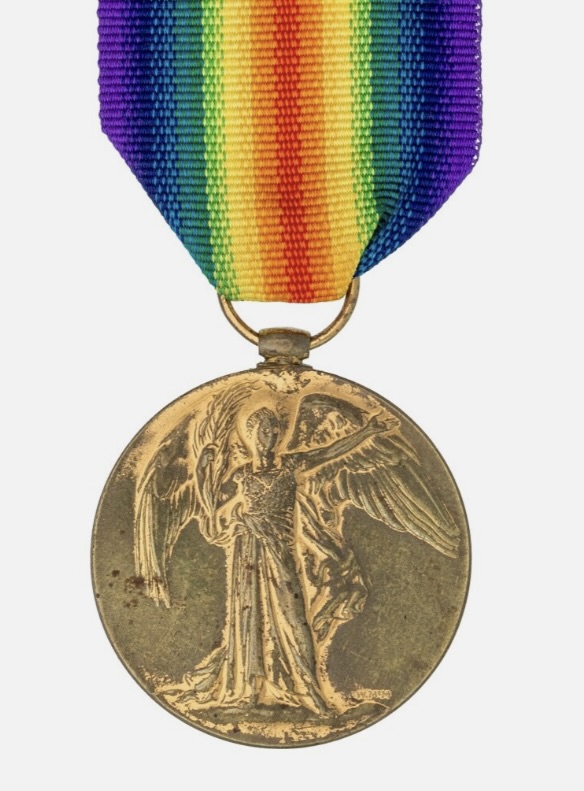
The three First World War Medals,
Top to bottom:
The 1914 Star, The British War Medal, The Allied Victory Medal
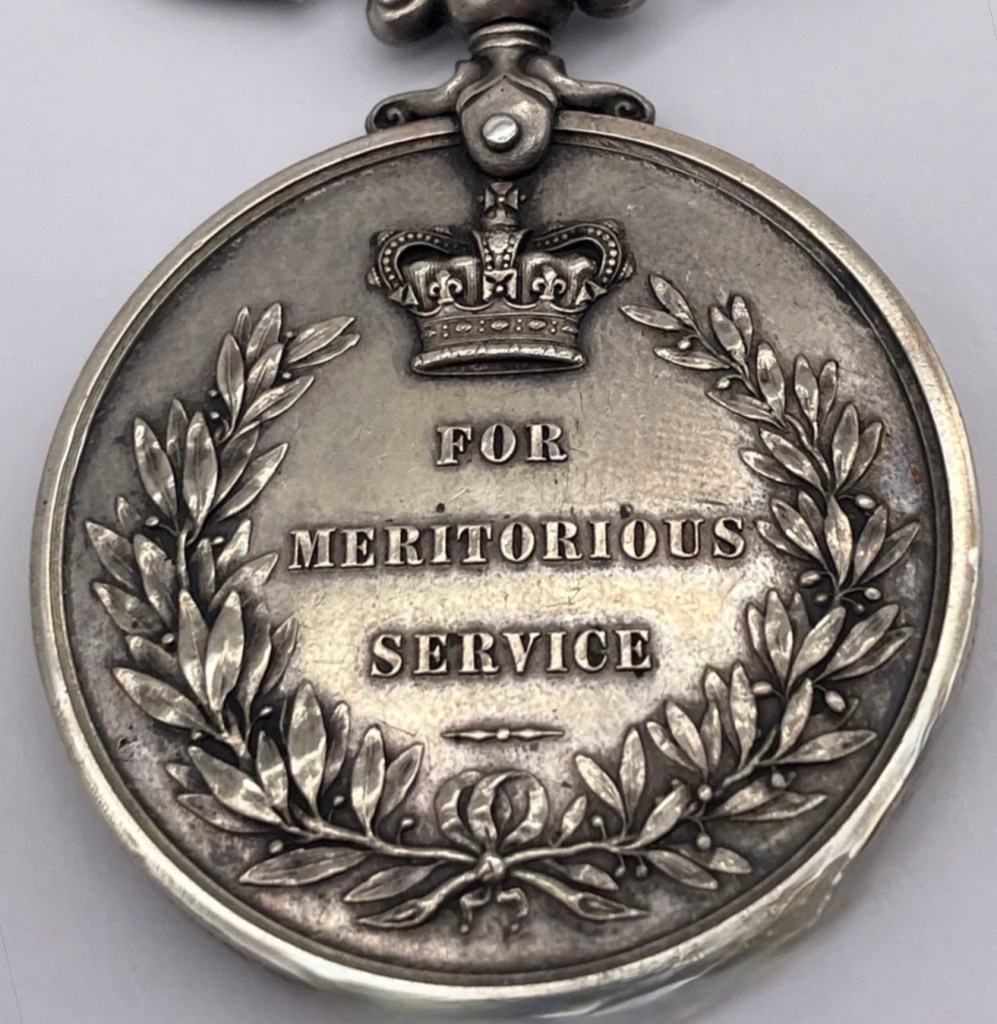
Medal for Meritorious Service
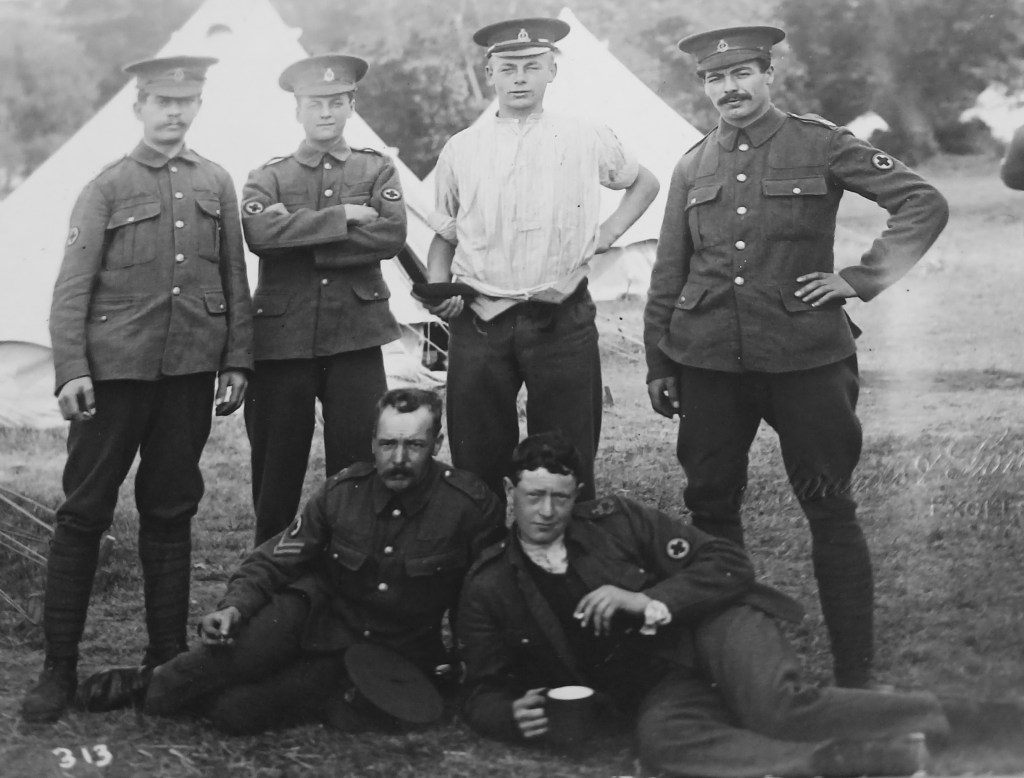
Ted, on the right, in the R.A.M.C uniform
After Ted came back to Eagle House, he didn’t return to Post Office Work. Instead he worked for the Great Eastern Railway (G.E.R.), which amalgamated with London and North Eastern Railway (L.N.E.R.)in 1923. He would rise at 4.30 a.m. every day and cycle the ten miles to Ipswich Station. (Up and down Bishops’ Hill.)There he remained working as a Porter and a Guardsman until his retirement in 1952, having completed thirty one years of service. `The Felixstowe Stationmaster, Mr W.A. Meehan presented Ted with a barometer, pipe, tobacco and a tobacco pouch, saying,
I shall be sorry to lose…(Ted), he has been a good friend to me as well as a good member of staff.’
He made many friends and no enemies. Sixty four of his colleagues attended his presentation, witness to his popularity. During the Second World War he signed up as an Air Raid Precaution Officer, once again helping people during a time of danger. He was instrumental Helped in establishing the British Legion in Trimley, Kirton and Nacton . Trimley branch finally close in 1996. Lily was also involved in with the British Legion as well as the Mother’s Union. Both of them were active in the service of their community before moving to Wiltshire to be closer to their daughter.
Taken in 1952, I think the sweetness of Ted’s disposition is evident in the photograph below.
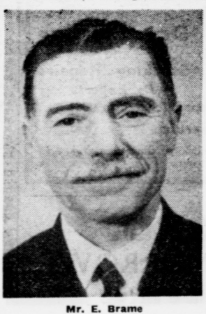
Karen told me about Ted in a series of emails. I will let her finish this article in her own words:
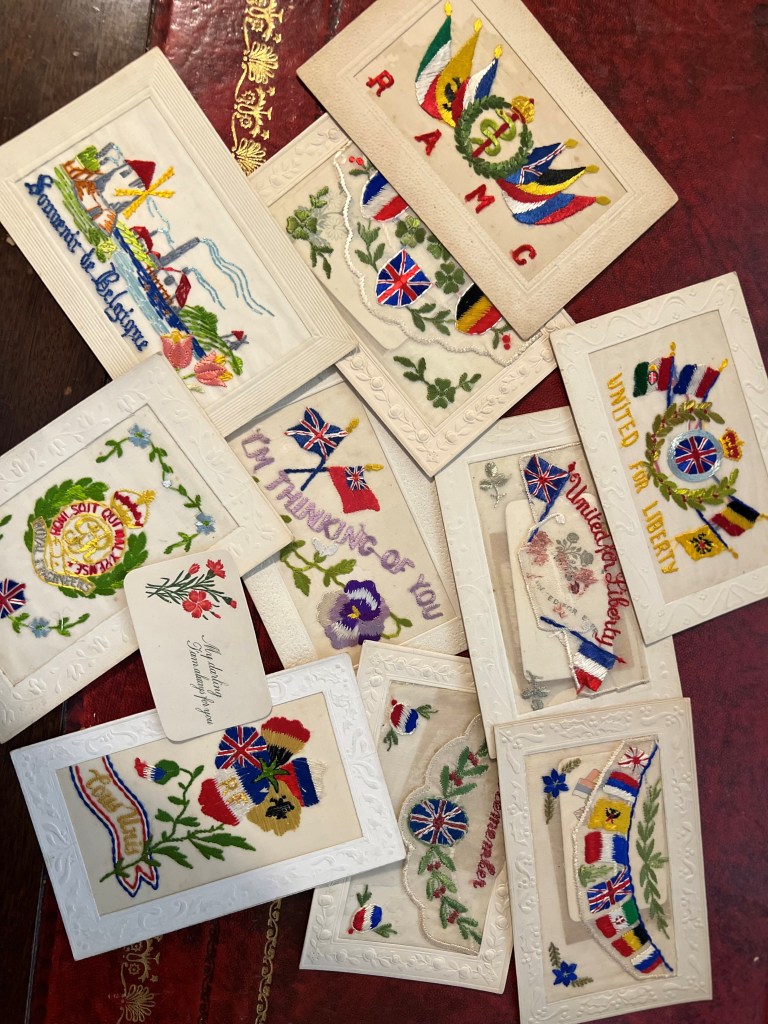
“I have …(Ted’s) …service record book, a brief diary and many of the embroidered cards he sent to my Great Gran. I also have humorous cards he sent back to England.
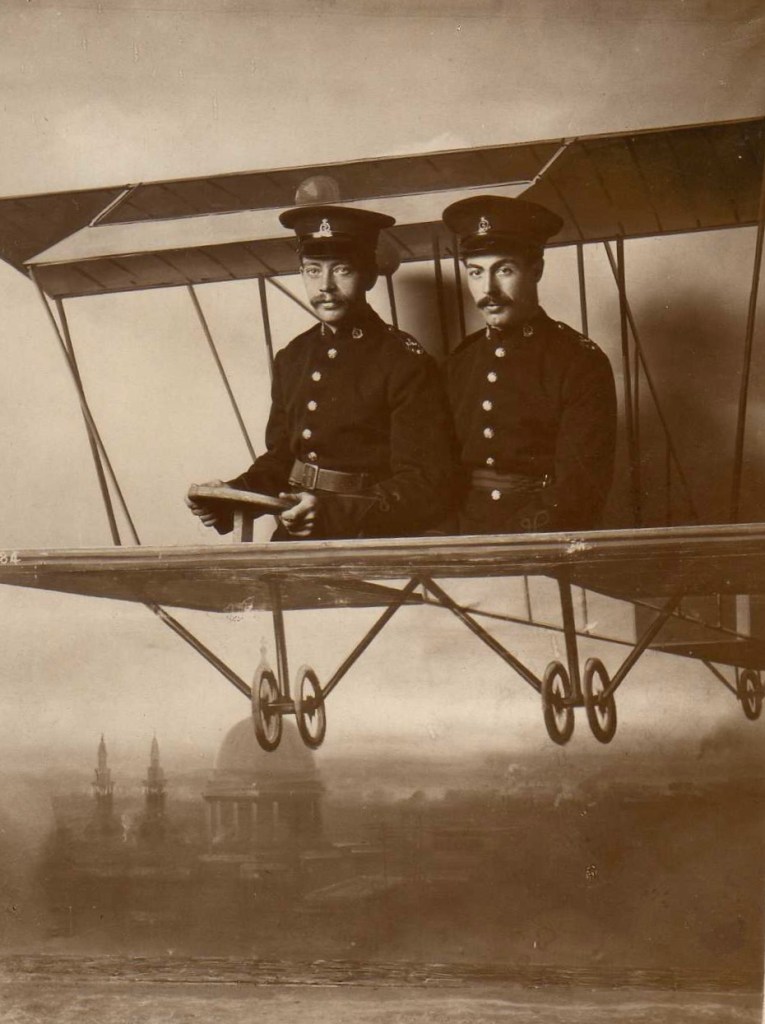
Humorous photograph taken at Otto Brown’s Studio in Worthing
I was lucky to have known my Great Grandad, because he lived such a long, full life. He was a very gentle soul; everyone adored him. Little did we know what horrors he had experienced…he was also an ‘Old Contemptible’, which was the name given to surviving soldiers of the British Expeditionary Force (BEF) who fought in France and Flanders between 5 Aug and 22 November 1914. According to Voices of War and Peace[i],
“These were men who were brave, patriotic, comradely, self-sacrificing, dogged and unconquerable.”
What is important to acknowledge is that Ted was non-fighting.
Ted was my absolute favourite. My Great Grandmother was a tiny lady, a formidable force, and Ted, with his calm, smiling nature, balanced their relationship. They were utterly in love until the end of their lives. Ted was incredibly deaf in his later years, and after my Great-Grandmother died (he was in his late nineties), I remember him loudly saying his prayers when he went to bed; he always told her he looked forward to being with her again…
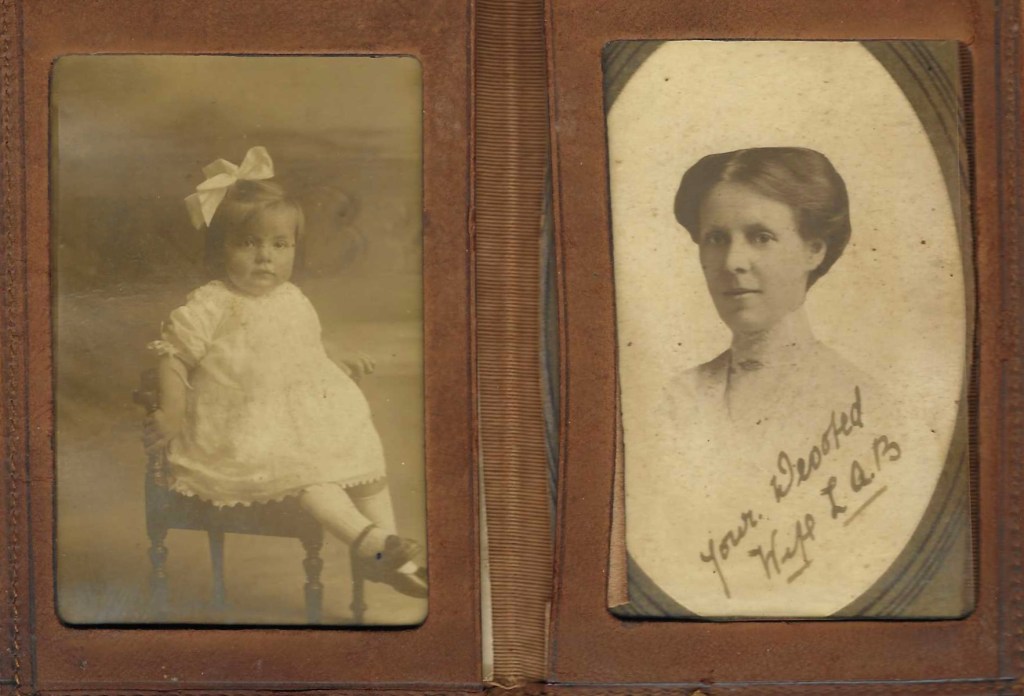
Ted came home from the War in 1919 to his devoted wife, Lily and the small child Madge whom he scarcely knew and was then five years old. He couldn’t visit …(Trimley)…during those five years. When he returned home to Trimley, he found Little Madge in the front garden playing and asked her, “Whose little girl are you?” She told him, “I’m Madge Brame”, and he said, “Then I am your Daddy”.
***************************************************************************************************************************
I have several people to thank for facilitating this brief narration of Ted’s story. Its origins arose through a series of coincidences. The generous donation of the Post Office property documents from my kind friend Kitty led to the Blog about the building and its’ occupants, notably the Brames. The unexpected gift of the postcard of ‘The Boy Ted’ from the late Peggy Kellard, a former Post Mistress, helped me identify a previously anonymous young man as Ted. The Blog about the Post Office resulted in Ted’s Granddaughter-in-law, Sue Townsend and her daughter Karen contacting me. They generously loaned documents and photographs about Ted and his home, Eagle House/Lodge. Karen provided all the details of Ted’s military engagements. The result is the revelation of a modest man who appeared ordinary on the surface but through his dedication and bravery revealed himself to be extraordinary. As with all those pulled into a war not of their making, Edmund deserves to be remembered because of his commitment to serving others and enabling them to heal and live again at the risk of his own life.
Thank you.
What is important to acknowledge is that Ted was non-fighting.
Ted was my absolute favourite. My Great Grandmother was a tiny lady, a formidable force, and Ted, with his calm, smiling nature, balanced their relationship. They were utterly in love until the end of their lives. Ted was incredibly deaf in his later years, and after my Great-Grandmother died (he was in his late nineties), I remember him loudly saying his prayers when he went to bed; he always told her he looked forward to being with her again…
Ted came home from the War in 1919 to his devoted wife, Lily and the small child Madge whom he scarcely knew and was then five years old. He couldn’t visit …(Trimley)…during those five years. When he returned home to Trimley, he found Little Madge in the front garden playing and asked her, “Whose little girl are you?” She told him, “I’m Madge Brame”, and he said, “Then I am your Daddy”.
I have several people to thank for facilitating this brief narration of Ted’s story. Its origins arose through a series of coincidences. The generous donation of the Post Office property documents from my kind friend Kitty led to the Blog about the building and its’ occupants, notably the Brames. The unexpected gift of the postcard of ‘The Boy Ted’ from the late Peggy Kellard, a former Post Mistress, helped me identify a previously anonymous young man as Ted. The Blog about the Post Office resulted in Ted’s Granddaughter-in-law, Sue Townsend and her daughter Karen contacting me. They generously loaned documents and photographs about Ted and his home, Eagle House/Lodge. Karen provided all the details of Ted’s military engagements. The result is the revelation of a modest man who appeared ordinary on the surface but through his dedication and bravery revealed himself to be extraordinary. As with all those pulled into a war not of their making, Edmund deserves to be remembered because of his commitment to serving others and enabling them to heal and live again at the risk of his own life.
Thank you.
You may like to take a look at other Trimley soldiers of the First World War:
If you have any comments or would like to be part of the Trimley St. Martin project, please contact me at:
trimleystmartinrecorder@gmail.com
Liz Rastrick
Trimley St. Martin Village Recorder
10th February 2026
[1]approximately £3.00 in 2026 terms
[2] Official march of the R.A.M.C was ‘Her bright smile haunts me still” – You can listen to a recording made in 1919 on Youtube. Her Bright Smile Haunts Me Still – Edward Johnson https://www.youtube.com/watch?v=ytfAQ_JAfkk&list=RDytfAQ_JAfkk&start_radio=1
and also a more recent version
https://www.youtube.com/watch?v=hB23ZpMjt7I
[3] https://api.parliament.uk/historic-hansard/commons/1914/aug/03/statement-by-sir-edward-grey
[4] Royal Army Medical Corp 1911
[5] https://www.iwm.org.uk/research/tracing-your-family-history/objects/first-world-war-service-medals
[6] .[https://www.voicesofwarandpeace.org


Dear Liz,
What a remarkable retelling of a Trimley Hero. I shall not walk past Eagle House without having a thought for Ted Brame. Such an appropriate time for publishing his story. Thank you, Liz for all your care and research.
LikeLike