The Post Office and some of the people who worked and lived there
Nothing disturbs the tranquil road outside Trimley Post Office. With its high dormer window, the building sleeps languidly in the light of an early twentieth century afternoon. A pony and trap stand directly outside in the sunshine, its owner occupied elsewhere, possibly taking the photograph. Beyond, the two sister churches of St. Martin and St. Mary present themselves as both places of worship and a visual tourist attraction. On the immediate left a small antiques shop makes its appeal to the same visitors.

1) View of the Post Office and two Trimley Churches
Other than the traffic which now blights the High Road, it’s a view which remains easily recognisable to current day appearances, The photograph above doesn’t indicate the inner life of the building but be assured the occupier was a hard working shopkeeper as well as a public servant.
There are two threads woven into the fabric of this building. One is its business functionality, namely offering Post office services and the facilities of a general stores to the public. The other is the owners and occupiers of the property. A short explanation of Post Office history may help to explain how both threads interacted with each other.
Background to the Postal service
It was Henry VIII who created and commanded a Master of Posts, Sir Brian Dukes, to set up a series of ‘Posts’ by which messengers could carry letters of Court. Charles I proclaimed this royal service might be used by the public and this was later consolidated by Charles II who when the service became the General Post Office with a Post Master General. Private letters were unofficially allowed to be included in the Postmen’s bags. It was incumbent upon the sender to pay for the delivery. The central distribution area for countrywide mail was London and anything approximating to a sorting office was absent. At some point in the eighteenth century a red livery was chosen for the postal service. With the advent of improved road surfaces, thanks to John Macadam and Thomas Telford, a time-tabled mail coach service was inaugurated in 1794, which was inevitably susceptible to attacks by robbers. Hence the introduction of an armed guard whose duty was to the protection of the mail and the passengers. His weapons could be a cutlass, blunderbuss, pistols or a combination the three. The guard had the additional responsibility of blowing a horn to inform other travellers to make way. Letter drops were made a various ‘posts’ along the route. The Stage coaches went directly from London to Ipswich and then on to Great Yarmouth. (Exactly the same route as the Yarmouth fresh herrings took.)
As the service moved into the nineteenth century, post masters or Post office receivers began to be appointed, often operating from their own homes. They were required to have an aperture whereby people could post their mail. People would deposit their letters with the appointed individual to ensure delivery. They were then despatched either by the Post Boy or to the Mail coach. Good proximity to the service was regarded as a desirable feature as may be seen in this advertisement in ‘The Ipswich Journal’:
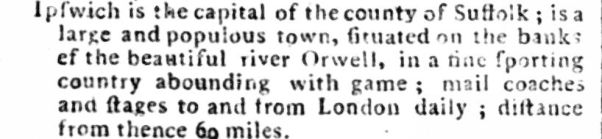
2) The Ipswich Journal 14th Dec 1799
The speed of delivery, if unimpeded, could be good. Trimley St. Martin’s Lord of the Manor, George Nassau, lived at 12 Carlton Terrace in London. His regular correspondence with his Ipswich Attorneys, Wenn and Dunn was quick and replies could be turned around within twenty four hours. It has been stated that Post Office Receivers were paid 1d for every ten pieces of mail received and a
“…further £1 per annum for each mailbag received from the passing mail coach”. 2
By the 1840s, the Postal service began to expand. The introduction of the Penny Black in 1840 was the world’s first postage stamp and was brought about by Roland Hillier’s active campaign to standardise postal charges and reform the service. The Penny Black was valid from the 6th May 1840.
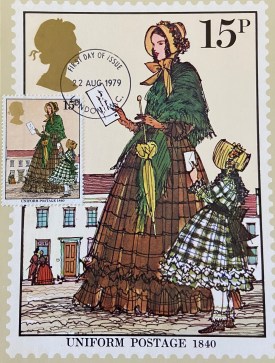
3) 15 penceStamp designed by Eric Stemp, commemorating the introduction of uniform postage.
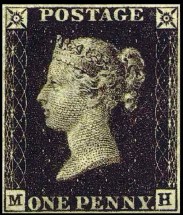
4) Penny Black first issued 1st May 1840
Within a decade, chargeable letters had increased from approximately three hundred and fifty items per year to seventy-six million. In 1870, two introductions affected Postal services growth in the final quarter of the nineteenth century. Firstly, Forster’s Education Act in 1870 was responsible for improvement in literacy levels and in the same year, plain postcards were introduced as a quick and cheap form of communication; the text messages of the day. The later arrival of cards with images on one side created a collector’s delight. The concise message provide a glimpse into the ordinary lives and concerns of their writers and their recipients.
But when James Woods was the Post Office Receiver for Trimley St Martin, these pleasures lay in the future. The first we learn of his role is in the 1841 Census but we don’t know how long he held the post. The 1844 and 1855 editions of White’s Suffolk Directory state that in addition to managing the functions of early Post Office, his principle occupations were as a plumber, glazier and painter.
“Woods, Jas…. Post Office…letters despatched ½ past 4 afternoon…” (1844)
“Post Office at James Wood’s. Letters via Ipswich.” (1855)
James Woods was still conducting all four careers from the same location in 1861 and with help he was to retain the position of Post Master until his death in 1875. Throughout this period James Woods lived next door to a Mr. Aaron Kent and this conveniently leads to short history of the Post Office building’s.
Owners and Occupiers.
The Post Office building is old, its titles deeds dating back to 1803 but an earlier mention of the property on the site, may be found in the manorial Rental Books of the eighteenth century. It was the principle building in a lot of four houses and to this day the house on the left of the Post Office on the postcard below, remains part of the Shop and Post Office; it is now the Manager’s office. It was much later in the nineteenth century before its postal functionality solidified and merged with that of the occupier. Tracking the owners of the property in conjunction provides an insight into the interconnectivity of village inhabitants until the arrival of the first of the first General Stores and Post Office.
The first recorded owner in 1803 was James Scarlett, a farmer with land close to the building and elsewhere in Trimley*. He was sufficiently monied and landed to deem it worth his while to belong to the Colneis Hundred Association, taking his position among other comfortably placed land holders. The property belonged to the Lord of the Manor, George Nassau, who sold several other properties at this time. Scarlett didn’t hold on to the property for long, selling it in 1807 for £126 to Aaron Kent, a Master Carpenter and sometime butcher. This translates into about £8,823 in 2023 terms and is probably now worth something in excess of £400,000. Aaron married Betsey Turtill by Licence in St. Martin’s Church in August 1810 and they had two children, one of whom was Eliza. (As a small point of interest, Betsey was was the daughter of James Turtill, the former Landlord of The Mariners.)
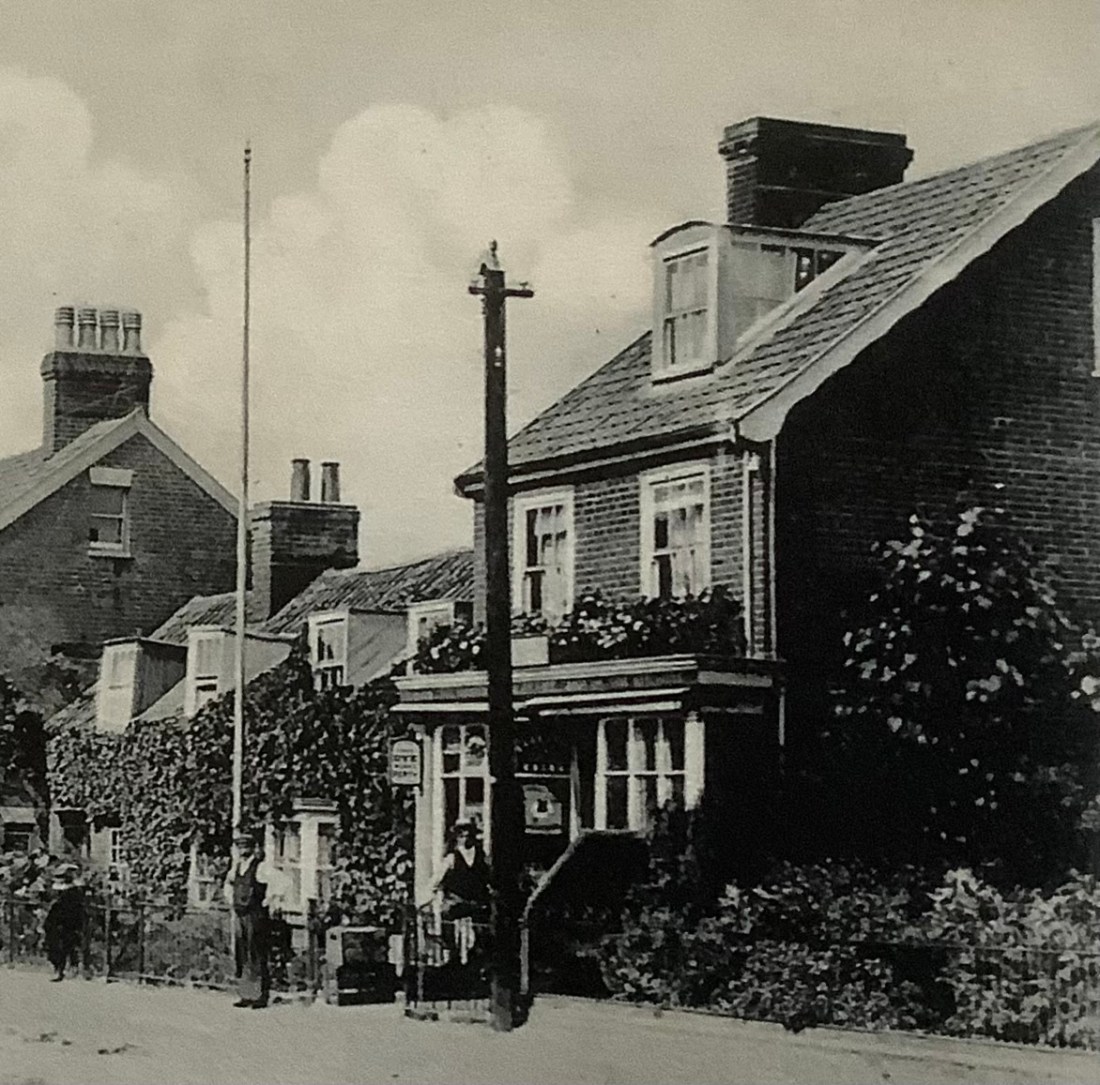
5) View of the Post Office looking towards Ipswich, 1910.
Both were Dissenters as was recorded when their two children, George born in August 1811 and Eliza, in August 1815 were baptised. In 1834 Eliza entered into a short-lived marriage withTimothy Hunnibal in St Nicholas Church, Great Yarmouth. She was widowed by 1841. They had at least two children, Eliza born in 1834 and Anna Matilda 1837. In September 1843, Aaron Kent sold the property to his widowed daughter Eliza Hannibal for a nominal £19. His rational was that she was his only daughter and this was his way of providing for her security in the absence of a husband.
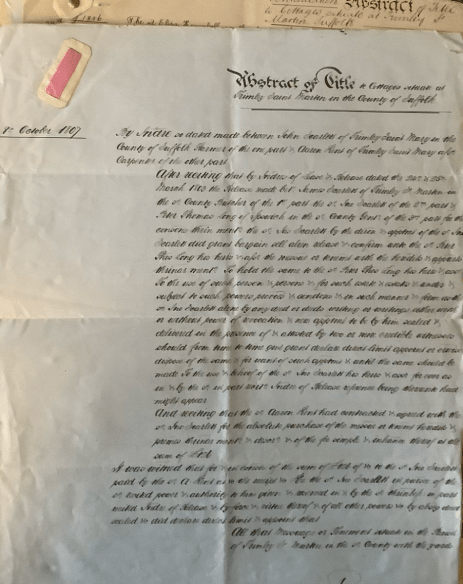
6) Abstract of title 4 cottages situate in Trimley St Martin in the County of Suffolk. The transference of the buildings from Aaron Kent to his daughter Eliza Hunnibell
Aaron continued to live in the property as a ‘boarder, supported by his cousin, Elizabeth Horne as well as his daughter. Eliza waited until after his death in 1855 before she re-married. Both Eliza and her husband William Dore subsequently lived in Harwich. It was Eliza’s second daughter Anna Matilda Hannibal who remained in the building with the much older ‘cousin’ Elizabeth Horne until the latter’s death in 1867. Just prior to Eliza’s death in 1870, her husband, William, rented out the property to William Gorham, the newly nominated Sub Post Master who operated Post Office services from the building. James Woods retained the position of Postmaster, living in the Meeting Yard immediately behind the Post Office until his death in 1875. Rather like James Woods, William Gorham combined his Post Office duties alongside his trade as a Cordwainer, or shoemaker. He was to remain there until his death in 1891. White’s 1876 ‘History, Gazetteer and directory of Suffolk’ stated:
“Post office at Mr William Gorham’s. Letters arrive at 6.5 a.m. from and are despatched at 8.30 p.m. to Ipswich, but Walton is the nearest Money Order Office.”
Significantly, Walton Post Office was the closest telegraphy point, an important service which didn’t arrive in Trimley until about 1901, although the nationwide General Post Office had been given control of the Telegraph system in 1870.
In 1880 the four properties were sold for £300 to George Jacomb of Trimley St. Mary with a mortgage for £100. It was described as abutting the grounds of the late James Scarlett. George appears to have had diversified roles as a Grocer, Organist and music teacher. He worked as a Grocer and draper and in 1885 became an agent entrusted to sell ‘The Ipswich Journal’ as well as take orders for advertisments in the same newspaper. As a well respected member of the community, he also became part of the Vestry Committee until 1893.
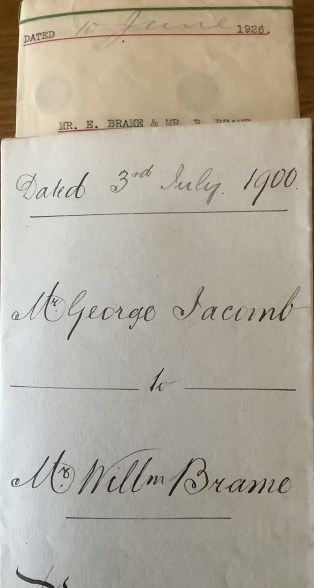
7) 3rd July 1900. Sale of property to William Brame to George Jacomb
It was George Jacomb who owned the Grocery shop whilst William Brame ran the Post Office. He sold the Post Office property To Willie Brame in 1900. When George died at the age of 89 on the 15th February 1919 his former occupation was a noted as a retired Grocer. He continued to live three doors from the Post Office until his death.
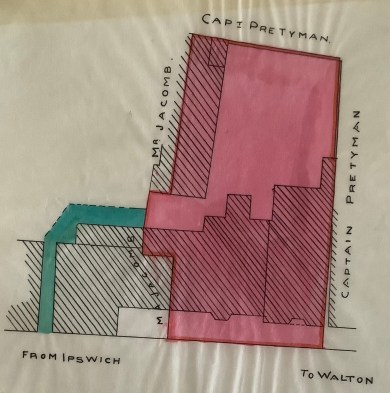
8) Footprint of the Post office building in 1897. Note the land on either side of Jacomb’s is owned by Captain Pretyman, who had inherited them from Colonel George Tomline.
By 1891 Catherine Gorham, wife of William had become involved in the business. This may have been through necessity as William was now 72. She was the Post Mistress and William was the Sub Postmaster and Shoemaker, but not for very long. He died in 1891 and everything moved around. The man who stepped into William’s shoes was his employee, ‘Willie’ William Brame. Born in Stowupland in 1855, some twenty five miles away, Willie and his wife Phillis who came from Kenton, were typical of the ‘incomers’ who arrived in the village in the second half of the nineteenth century. Good practical skills, combined with a solid work ethic and the determination to ‘get on’ were always going to be stepping stones to success. And get on he did. The Post Office Directory for 1888 records his presence as a Grocer and this combined with Post Office responsibilities was a recipe for success. By 1897 he was in the position to buy the property from George Jacomb with a mortgage of 3%.
9) The Post Office c.1910
The business was a whole family affair. William ran the Grocery side of the business, while his daughter Amelia assumed the role of Post Mistress. By 1901, his 14 year old son, Edward Brame, was working as the telegraph messenger boy. By the time of the First World War, Edward was otherwise occupied. The telegraphy service fell to someone else as did the difficult task of delivering fatal news contained in unwanted telegrams would have been a difficult task.
The shop sold a multitude of everything: string; cheese; dyes; eggs; bacon; paint; dress making fabrics. Everything a small community required. And postcards, of course, for the passing tourists. The younger sons, Bertie and Stanley, may have acted as delivery boys. Integration was easier for them than other incomers with the shop and Post Office acting as a community meeting point where gossip and news were exchanged. Although not local to Trimley, Willie Brame and his wife Phillis knew everyone. As a shoemaker he would first have met their feet. As a Grocer he met their earthly necessities.
Such was his success, he was financially enabled to purchase a second property on the other side of the road, Eagle House.

10) Eagle House is the cream coloured house in the foreground. The Post Office is directly opposite. View from the church tower. 2018.
William continued working until his death 19th February 1926. Probate granted the properties to Edmund and Bertie Brame, the sub postmaster. However, there was confusion surrounding the will and it was re-examined in 1932. As a consequence it was determined that Phyllis should have received all the properties left by her husband, including Eagle House and the Post Office and so, she did. Bertie continued on as Postmaster, living in the property together with his widowed mother, Phyllis and sister Hilda who continued working with Bertie. As a significant member of the village he became a Parish Councillor. Phyllis died in 1944, aged 92, leaving Eagle Lodge to Edmund and the Post Office to Bertie Brame. Bertie later sold the property to Jack Ernest Burrows in January 1952 and after a short retirement, died in 1953. In his Will, Bertie left a total of £1650 to his sister (Evelyn) Hilda Brame and thus ended over sixty years of connection between the Brame family and the Post Office.

11) The Post Office fronted by the Telegraph Pole which enabled Telegrams to be sent. 1910.
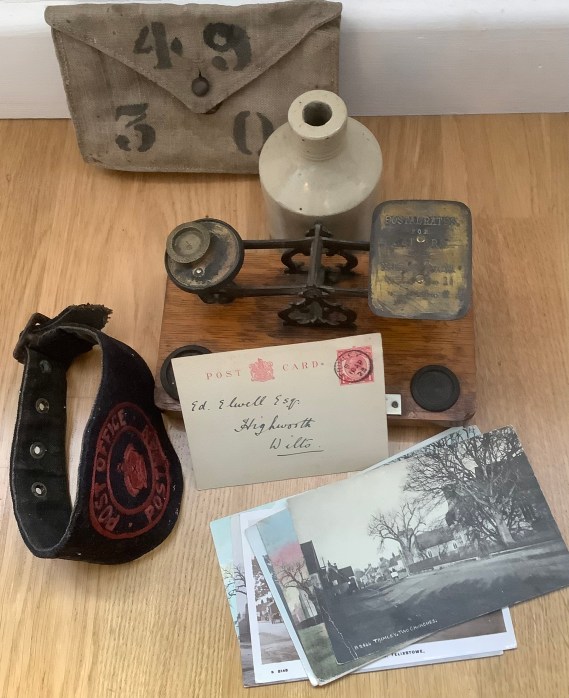
12) Some of the official impedimenta from earlier days at Trimley Post Office. A canvas message carrier. A Postman’s armband, scales, a stoneware bottle of ink, a plain postcard sent from Trimley and general post cards of Trimley.

13) The reverse of Canvas carrier. Letters or Telegrams?
Jack Burrows bought the property and the goodwill and Grocery business for £2,000. The building continued to operate as a Post Office and Grocer’s Shop. It was then bought by Cyril Hope in 1960.
In 1976 Steve and Kitty Moss took over the business. By then, The shop presented a more streamlined appearance. (The presence of the workmen involved in local building works encouraged Kitty to bake nearly two hundred bread rolls at 5 a.m. every morning.) In 1987 the Post Office was bought by Bert and Peggy Kellard, who had worked with Kitty. It was sold again in 1996. Peggy and her son Mike Kellard then went to neighbouring Kirton Post Office and shop where they remained until 2006.

14) Peggy Kellard and Kitty Moss, two former Sub Post Mistresses of Trimley Post Office.
May 2023
In the last few decades the business has been operated by larger chains, although the Post Office facility has remained. It had been part of the McColl’s franchise in the two thousands before becoming a Morrison’s Daily in the Autumn of 2021. It remains a vibrant focal point for both the Trimley providing the essentials of daily life as well as communication point to the wider world.

15) April 2020. The Post Office during the time of Covid.
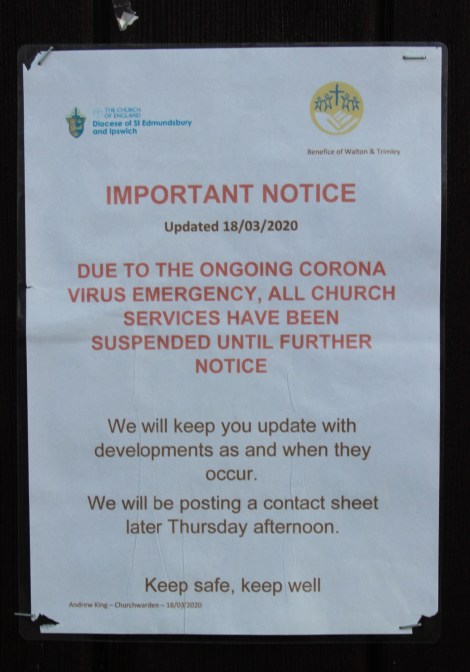
16) During the Covid pandemic, the Post Office stayed open serving the people of Trimley. April 2020.

17) The Post Office received recognition for their hard work throughout the first Lockdown from Trimley St Mary Parish Council. Photo courtesy of Lynn Beal.
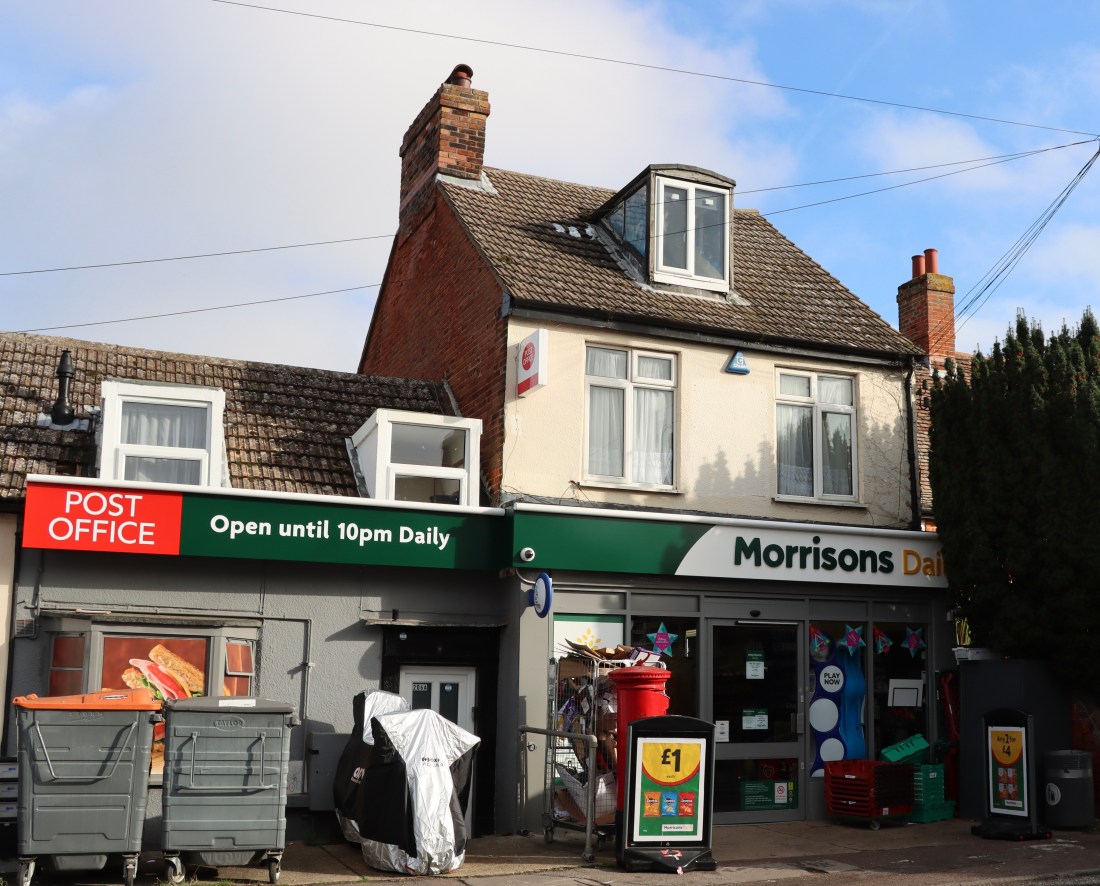
18) November 2021. Morrisons take over the Post Office

19) November 2021. New Morrisons frontage
Two thoughts come to mind about the Post Office. Firstly, the longevity of the Postal officials before 1996. Secondly, the number of women who have worked there since the nineteenth century. Dedicated and hard working, they were professionals working in a time before such opportunities were generally available to women.

20) An aerial view of the Post Office. The red star indicates the back rooms of the Post Office
Courtesy: Google Maps
If you have any comments or would like to be part of this Trimley St. Martin project, please contact me at:
trimleystmartinrecorder@gmail.com
LR 17/05/20242024
*****
*James Scarlett mentioned above, the first named owner of the Post Office property, was the brother of John Scarlett and father of Dameroon, both of whom had connections with the Hand in Hand.
Additional articles about the use of postal services from Trimley may be found at:
Kitty Moss: Artist, Advertising representative, Post Office worker, wife and mother
https://trimleystmartinrecordersblog.com/2019/07/19/trimley-tourist-destination/
https://trimleystmartinrecordersblog.com/2020/08/20/questions-on-the-back-of-trimley-postcards/

 Trimley St Martin Recorder's Blog
Well done Liz, thank you for all your hard work. Fascinating blog about one our Trimley villages mainstays . It has sparked several questions/memories. Some that I can answer, and others I need to research myself. Liz, I will email you separately about them in due course.
LikeLike
Thank you Barbara. I suspect the KENTs may have attracted your attention. Look forward to hearing more from you. Liz
LikeLike