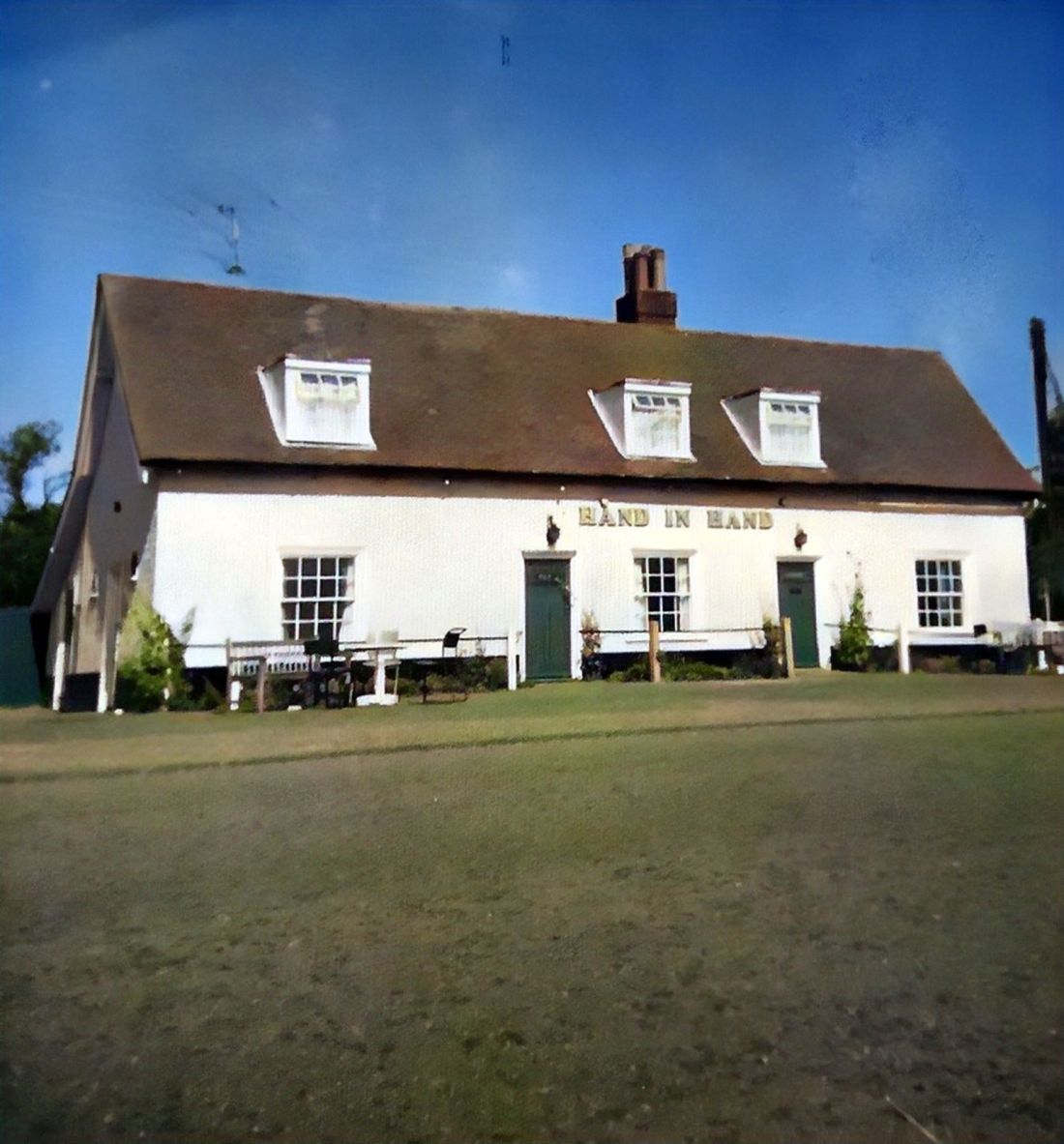
The Hand in Hand, sometime in the nineteen seventies.
Courtesy of the late Rosemary Gitsham
There are two excellent pubs in the Trimleys. ‘The Mariners’’, located in Trimley St Mary has several historic mentions dating back to at least the end of the seventeenth century, although the building it occupies was only built circa 1780. The ‘Hand in Hand’, situated in the middle of Trimley St Martin is of more recent origin, but can only date its service history back to the first half of the nineteenth century, although it may be the older building. Historic England gives a brief description of ‘The Hand in Hand’ without necessarily having been inside the building:
‘Public house, late eighteenth century. Timber framed and plastered with plain tiled roof, brick stack on east roof slope. One storey and dormers. Twentieth century addition to right hand end two windows: sashes in flush frames with glazing bars; three flat headed twentieth century dormers’ [i]
I’m not favouring one hostelry above the other but for now my focus is on ‘The Hand’ as it is known locally, not least because it is a mere five minutes from my house and therefore easily researched during opening hours.
Trimley’s ‘Hand’ can’t claim to be unique but in 2024 it would seem there are only four other pubs with the same name across England. There used to be one of the same name in Ipswich but know the Trimley ‘Hand’ is the only one in Suffolk. What is the origin of the name of this pub? Sometime around 1960, a Sign writer created a clear and visible explanation. On his hand-painted board he depicted two men facing one another, each with an arm and hand out-stretched, grasping hand. The one on the left was a farm worker, the one on the right, a sailor. The message was: Trimley is where land meets sea and also, Friendship. The welcoming Sixties sign has long since disappeared. The image below was its immediate replacement in the early Seventies and fails to demonstrate the connection of land and sea in such a marked manner but rather it presents a romanticised image of companionable land work between labourer and farmer, which doesn’t really deliver the same message. Latterly, the pub sign has been words only but of course, the name remains. Sign writing would appear to be a fading art in these days of computer-generated imagery.
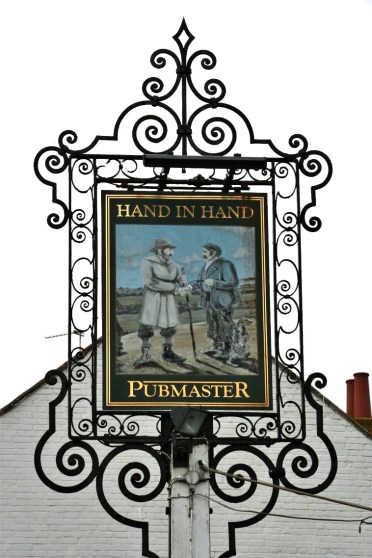
Hand in Hand pub sign dating from the early nineteen seventies.
Note the gable end of the Hand Row houses in the background.
It is quite possible ‘The Hand’s’ name reflects a different history. There is some evidence to suggest that in an earlier incarnation, the houses next to “The Hand” were a staging post used to change the horses on their way to and from Landguard Fort in Felixstowe. The military site has risen and fallen in military importance over the centuries and its existence may be dated back to the time of Henry VIII’s programme of east coast fortifications. During the French and Napoleonic Wars, it was considered of strategic importance and crucial to the protection of the confluence of the Orwell and Stour; both riverways to the Suffolk and Essex hinterland.
It could be the houses adjacent to ‘The Hand’ played a part in the Fort’s communication strategy. ‘Barrack Row’ was recorded in the Censuses of 1841 and 1851. The name certainly confirms a military function. It is believed the buildings were originally eight stables where horses for military use were kept. Each stable had a large metal hook hanging from the ceiling, ready to have the hay net hung for the horse feed. The hay was kept in a small room behind and the room above was used as both a Tack Room and a place for the grooms to sleep. Sometime around the end of the nineteenth century, the houses were sold and let out to tenants. By then, it was known as Hand Row. At least one house retained the hook well into the twenty first century, although the occupants didn’t understand why it was there. Today they present a smarter face to the world.
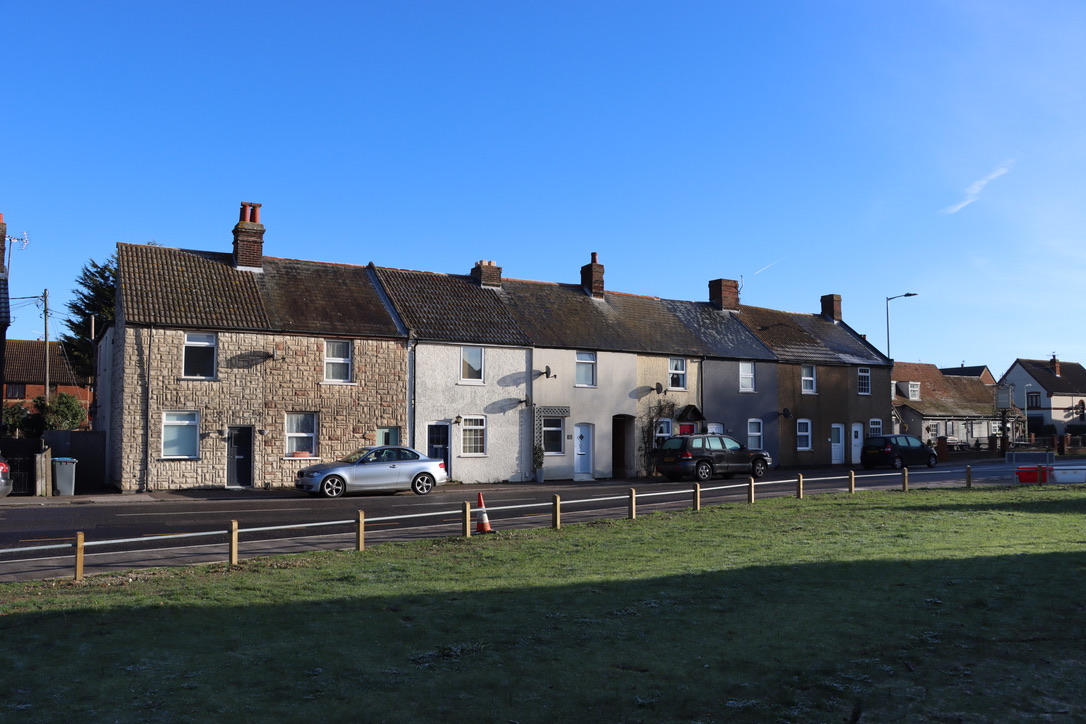
Hand Row Cottages, March 2023
The first appearance of the Hand in Hand building is documented when the Enclosure Act and map were drawn up in 1807. On the map three buildings sit snugly next to each other suggesting other structures may have been attached. Or not.
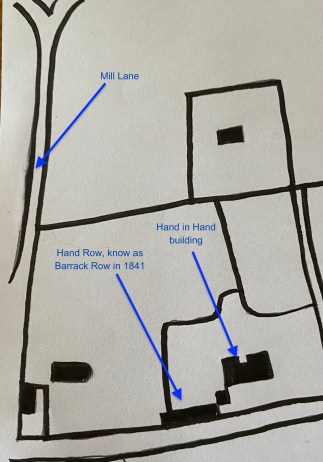
Copy of part of the 1840 Tithe Map for Trimley St Martin.
Barrack Row better known as Hand Row is now in evidence.
At that stage it may be assumed the principal building was a dwelling house. By the time of the 1840 Tithe Map illustrated above, the situation is a little clearer. On the map above Plot 129 is the site of ‘The Hand’ which was then owned by John Scarlett and occupied by “Thomas Warner and others’. The neighbouring plot 129a was occupied by Dammeron Scarlett and owned by John Scarlett, his uncle. A mere four years before in 1837, eight properties were sold by auction, one of which was occupied by John Scarlett and the other by Dammeron. I suspect the first Lot, the ‘…substantial Brick built Freehold Dwelling house…’ is the Hand in Hand as it is situated on Trimley Street and there were not many such buildings at the time. It certainly matches with the Tithe and Enclosure map records. John Scarlett, who had been a farmer, butcher and member of the Colneis Hundred Association, died in 1840. He was a man of good standing and some substance who left his property to Dammeron and his natural son, Horace Scarlett Oxer. Additionally, Dammeron was the Inn Keeper of ‘The Mariners’ between approximately 1840 and 1851, as recorded in the two censuses. Brewing appears to be a consistent occupational theme amongst the Scarletts and important in the development of ‘The Hand.’
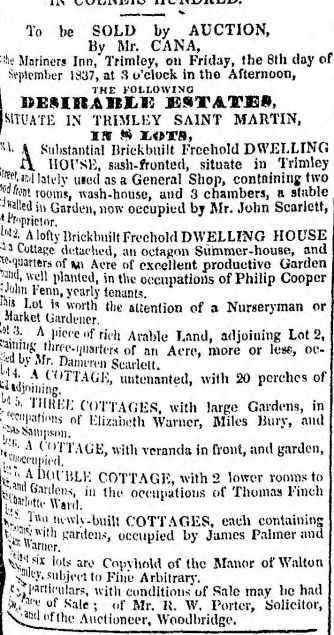
Ipswich Journal 2nd September 1837
If the ‘substantial’ property above was the ‘Hand’ then it would seem its life as a Beer House was yet to come, although this is by no means definite. Following ‘The Beer Act’ of 1830 the notion of Beer Houses was greeted with enthusiasm. Anyone who was a ratepayer could brew and sell their own beer if they purchased a license costing two guineas or £2/2/-, a sum worth approximately £200 in 2023 terms [ii] and across the nation that is exactly what people started to do, and Trimley residents were no exception. By 1839, an additional forty six thousand Beer Houses were operating, and the licensing face of Britain had changed. The Act was modified during the course of the nineteenth century enabling the development of many new outlets. It is no accident that the Temperance Movement came to the fore in the nineteenth century.
The two guinea fee may seem reasonable but there are at least two instances when this simple rule was not followed. In 1853 John Newman of Trimley St Martin who may have operated from ‘The Hand’ building was summonsed for the lack of a license.
PROCEEDINGS BEFORE THE MAGISTRATES AT WOODBRIDGE.
-On Wednesday, the 23rd instant, John Newman, of Trimley St Martin, shopkeeper, appeared to answer the complaint of P.C. James Moore, charging him with having on the 13th of March, at Trimley St. Martin, sold beer to be consumed upon his premises without a license so to do. The case being fully proved, and that Newman had received many cautions, he was fined £3l. and costs, and in default of payment within 7 days, a distress warrant to issue, and in default of sufficient distress, to be imprisoned in the County Gaol, at Ipswich, for one calendar month, unless, &..
Suffolk Chronicle, 26th March 1853
The Scarletts’ brewery operations didn’t always adhere to legal requirements. In 1867 the following case was reported:
EXCISE CASE
James Scarlett, Trimley St. Martin, beer-house keeper, was charged with selling two pints of beer, which were drunk on the premises, on the 16th March last, he not having an Excise Licence to do so. Mr Chapman, Supervisor, appeared in support of the prosecution, and, Mr Pollard for the defendant. Mr Pollard said the case was brought before the Bench on the 28th March last by the police and the defendant was fined £2 and costs. The Excise now came forward as prosecutor, to recover the sum of £20, and he pleaded guilty and asked the Bench to reduce the penalty to one-fourth, and to ask the Commissioners to further remit the penalty. Mr Chapman said the penalty would probably be remitted to a nominal amount if the Bench recommended it. The Bench declined, and convicted the defendant in the penatly of £5. Mr Chapman applied for distress warrant to levy in case of non–payment, which was granted. Mr. Chapman did not apply for costs.
11th May 1867, Ipswich Journal.
The ‘beer-house’ is almost certainly ‘The Hand’ and it would seem that James Scarlett was not well placed to pay the license required to run a Beer House. Or perhaps he simply didn’t care.
The first clear mention of a Beer House in Trimley St. Martin appears in the 1871 Census. Mrs. Rebecca King, a widow aged 40, was the Inn Keeper in Trimley St Martin. It was acceptable for a woman to run a Beer House but not necessarily enter one as a customer. In the same year she left widowhood behind her when she married Garnham Esau Rampley Fiske who was five years younger than Rebecca. The ‘Married Women’s Property Act’[iii] was eleven years away and upon marriage what was Rebecca’s was Mr. Fiske’s and thus he became the Landlord, as is confirmed in White’s 1874 Directory of Suffolk. For some reason, Inn keeping was not for him and by November 1876 ‘The Hand’ was sold by Auction.
To Brewers and others
First-rate Beer House, with Early Possession
Trimley St Martin, Suffolk
To be sold by auction by John Fox
At the Golden Lion Hotel, Ipswich, on Thursday, the 30th November, 1876, at Six for Seven o’clock in the Evening.
The first-rate BEER HOUSE , with stabling, sheds, yards, gardens, and premises, known as the Hand-in-Hand, situate at Trimley St. Martin, and abutting upon the road leading from thence to Felixstowe; also, TWO COTTAGES, next same, the whole containing about 1½ acres, more or less. Printed Particulars and Conditions of Sale may be had of Mr. Porter solicitor; and of the Auctioneer, both of Ipswich.
Ipswich Journal 25th November 1876
By 1881, Rebecca and Garnham Fiske were living in Prospect Road, Ipswich. Today it is surrounded by houses and located three spits from the Bramford Road Traffic lights but then it benefitted from open fields in one direction, the River Gipping hard by and a ten minute walk to the all the shopping facilities of nineteenth century Ipswich. Rebecca died in 1887, aged nearly fifty and Garnham moved on to other places and relationships.
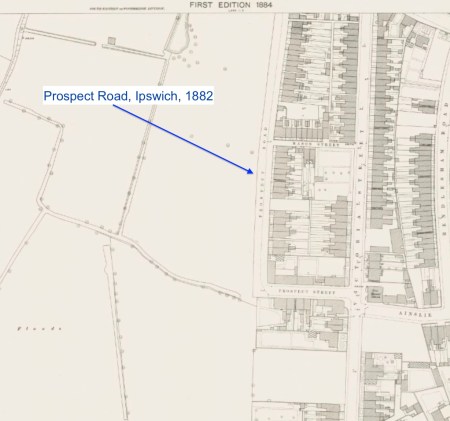
Ordnance Survey map Six inches to the mile, showing Prospect Road in Ipswich 1882
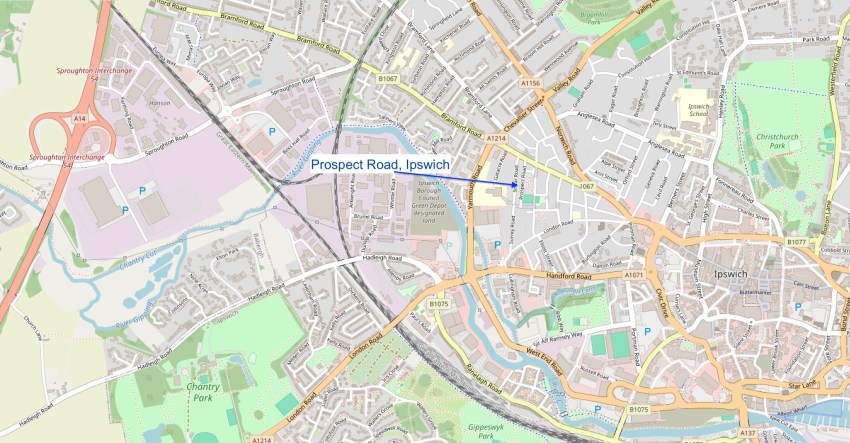
Prospect Road from Open Street Map of Ipswich 2024
The Fiskes were replaced by Isaac Punt who had been born in the nearby parish of Levington in 1850, Isaac had experience in the victualling trade. His father had been the Publican at ‘The Freehold Tavern’, on what is now the Foxhall Road in Ipswich, approximately ten miles away.
Woodbridge Magistrates Court
Charles Rattle of Walton, was summoned by Isaac Punt, of Trimley, Hand -in-Hand beerhouse, with refusing to quit that house on the 25th October, when required by the landlord at closing time. Defendant was fined 5/- and £1-11shillings costs.
Ipswich Journal 9th November 1882.
Petty SessionsOn Wednesday, before General Hessey (chairman), Major Rouse, Capt. Moor, and W. P. T. Phillips, Esq., …
George Forsdike, of Trimley St. Martin pleaded guilty to having assaulted Albert Newman, of that place, farmer , in the Hand-in-Hand beerhouse on the 21st ins., by striking him on the hat with a stick. Defendant was fined 5 shillings and 30 shillings costs, which he paid.
Ipswich Journal, 31st January 1884
[(Please note, 5/- in old money equalled twenty five pence and £1-11-0d equalled one pound fifty five pence.]
As may be observed from the newspaper cuttings about, like every Beer House owner Isaac Punt had his share of overly cheerful customers but was more than able to handle any truculence on their part. He remained at ‘The Hand’ from 1879 to 1885 but then moved away from Trimley to become a farmer in Great Bealings, never to return to the licensing trade. After Isaac came Arthur George Levett. His father had also been an Inn Keeper at ‘The Shepherd and Dog’ in nearby Foxhall. But perhaps Arthur preferred his primary occupation as a painter of decorator because in 1886 he left and by 1891 was working in the decorating trade in Ipswich. He was rapidly followed by another short term Landlord, William John Murrell, who departed in 1889 and could later be found living in Mill Lane. His difficulties may have been financial.
The next replacement was Benjamin James Newson, who remained at ‘The Hand’ for about ten years. He and his wife Sarah saw the births of their three children during this period and the need for the services of a, ‘strong, respectable, willing Girl..’, to help with increased domestic pressures.
WANTED
Strong, respectable, willing Girl as General. – Apply, Mrs. Newson, Hand-in-Hand, Trimley, Ipswich
Ipswich Journal,14th November 1895
But like those before, it was not to be a long residency. They moved out of pub to Walton and Benjamin specialised as a Pork Butcher.
There were several incidents of what might be termed rough behaviour between 1875 and 1900. This didn’t discontinue with the arrival of Robert Cotton in 1900 but does appear to have been dealt with firmly. Reports of drunkenness appeared in the papers, which didn’t add much to the pub’s reputation.
Petty Sessions
At the same Court, John Taylor, labourer, of Kirton, was summoned for having assaulted Robert Cotton, innkeeper, Trimley St. Martin, on July 15th.- Defendant admitted the offence, but said he did not strike complainant until complainant struck him. Complainant said defendant refused to go out of the house at closing time, and while he was putting him out, defendant struck him on the head cutting his eye. He did not strike defendant. Defendant was fined 30 shillings, including costs the Chairman saying he had struck the complainant a cowardly blow.
East Anglian Daily Times, 21st July 1905.
Later reports appear to have focused on the Quoits Team and other social events. I don’t doubt there were other incidents of “coarse” behaviour, but it would appear Robert Cotton had the measure of running a good pub. The property was owned by Tolly Cobbold who were based at Cliff Brewery in Ipswich and this lasted well into the late twentieth century. Perhaps the late nineteenth century landlords, Fiske, Punt, Levett, Murrell and Newson just couldn’t cut the mustard when it came to maintaining an orderly establishment.
Quoits
At a meeting held at the Hand-in-Hand, Trimley St. Martin, the following were elected to office in the Quoit Club: Rev. S.J. Banks; vice-president, Mr. H. Lummis;, treasurer, Mr. R. Cotton; secretary, Mr. W. Lummis.
Evening Star, 2nd April 1906
By 1911 Robert had been succeeded by Charles Cotton his son. He appears to have been a good publican or at the very least, one who was keen to extend the boundaries of what was on offer. We often think that food in pubs is a post Sixties initiative but look at this advertisement from the Felixstowe Times:
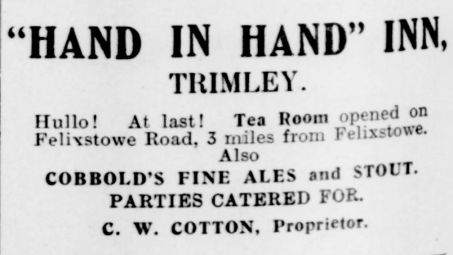
Felixstowe Times, 9th June 1928
‘The Hand’ benefited from the substantial garden and orchard to the side and rear of the property, which John Scarlett had enjoyed. For visitors to Felixstowe, a pleasant walk would have taken them into the countryside with its proximity to the beautiful River Orwell. Charabanc parties may have found a perfect destination. A twenty minute bus journey would have allowed for a simply topping afternoon out, with opportunities to purchase and send postcards. I have written before about the tourist attractions of Trimley in the early twentieth century, with its’ two sibling churches, access to the River Orwell and Grimston Hall, with its Thomas Cavendish connections.[iv] It is impossible to place too much prestige on the presence of Tea Rooms, then and now.
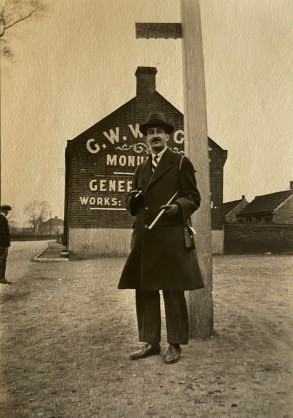
The Unknown Tourist outside The Hand in Hand, Easter 1930. If he was waiting for the Tea Room to open it wouldn’t have been served in the garden as it snowed on the day this photo was taken.
Charles Cotton remained in charge until about 1944 when he was replaced by Leonard Skippen, who was originally a small holder in the village. Leonard remained the Landlord for some time after the war although I’m uncertain exactly when he left.
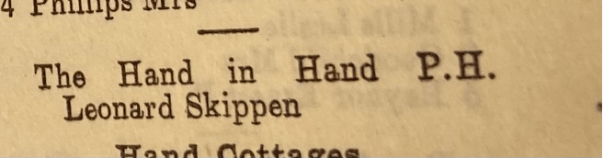
Entry in Kelly’s Street Directory for Felixstowe, 1950.
The Beer House was now a respectable Public House, a typical pub of the second half of the Twentieth Century. Regulars left their mugs there, whilst some had designated seats. Barbara Shout of Trimley St Mary told me her Grandfather, Fred Stannard, who lived in Hand Row,
“…had a seat in the Hand in Hand opposite the main door and if Fred was not sitting in it nobody else was allowed to. It was understood that the seat belonged to him. When Fred died in 1959 Olly, his daughter, ‘inherited’ his seat. Evening entertainment was playing cards but if you did this on a Sunday the blackout blind, a result of WW2, was pulled down. It was illegal to gamble on a Sunday, if the local ‘Bobbie’ caught you playing cards it meant you were in trouble.”
The pub was used well by the locals but few women ventured inside. Ollie mentioned above, was clearly an exception. It was largely an all-male preserve, apart from bar maids and the Landlord’s wife.
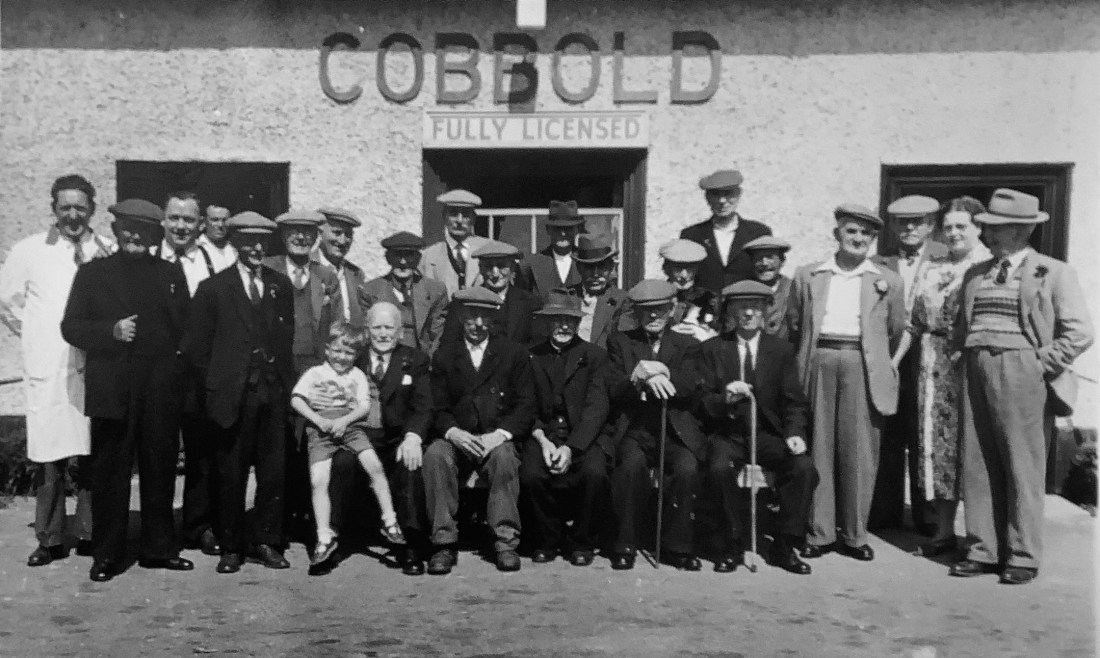
Outside the Hand in Hand, circa 1950, courtesy of Michael Speight. The man on the extreme left in the front row is Fred Stannard.
It was an archetypical public house, which anyone born before 1970 would recognise. But everything changes and I will write more of this in my next article about the current Landlady, Nicki Jennings.
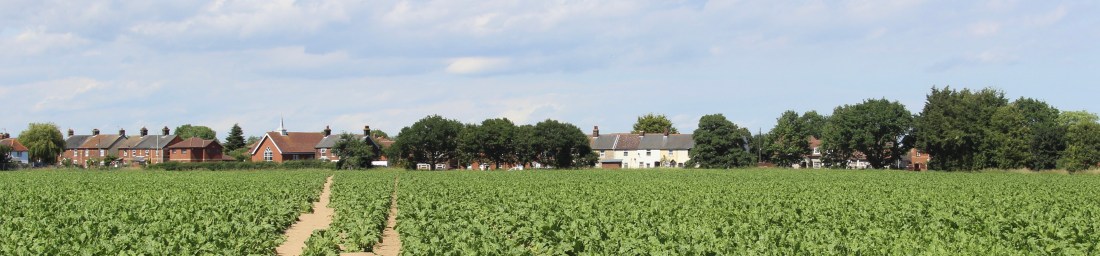
A distant view of the Hand in Hand across a field of sugar beet in 2018. It’s behind the trees on the right of the photograph
Addendum
Since publishing this article, a reader has been in touch with me to say that,
“… my parents were Harold and Mabel Miller, Landlord and Landlady of the pub. My brother, Paul Miller is the little boy sitting on our grandfather’s knee. My dad is next to the man in the white coat.”
Thank you, Sheila Smith, for this information.
If you have any comments or would like to be part of this Trimley St. Martin project, please contact me at:
trimleystmartinrecorder@gmail.com
LR 19/04/2024
[i] https://historicengland.org.uk/listing/the-list/list-entry/1377105?section=official-list-entry
[ii] https://www.bankofengland.co.uk/monetary-policy/inflation/inflation-calculator
[iii] https://www.legislation.gov.uk/ukpga/Vict/45-46/75/enacted#:~:text=Every%20woman%20who%20marries%20after,her%20after%20marriage%2C%20including%20any
[iv] Sir Thomas Cavendish, second Englishman to circumnavigate the globe.

 Trimley St Martin Recorder's Blog
Excellent, informative blog.
Fred Stannard earned his ‘pint’ money looking after the orchard and gardens. He had been grounds man at the Felixstowe Tennis Club for many years so had some experience. The Rattle family of Walton were known locally as the ‘donkeymen’, they provided the rides on the beach, keeping their donkeys on the field where the Grove Medical Centre now is. They appear in documents charged with ‘being drunk in charge of a donkey at Walton’, well known, but harmless. Benjamin Newson’s pork butchers shop (now a hairdressers) was known as ‘Porky Smiths’ in the early 1950s and was very popular with locals. My cousin’s father-in-law often supplied him from his pig farm at Fagbury.
Barbara Shout
LikeLike